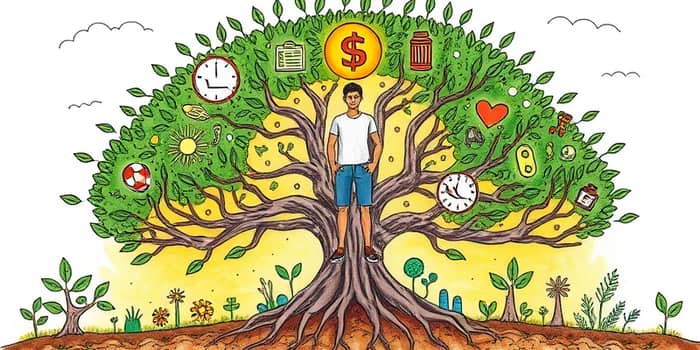
In today’s fast-paced world, your financial health extends far beyond bank balances. The concept of your personal economy reframes money as one part of a holistic system of resources. By consciously managing time, energy, attention, and finances, you can create a sustainable framework that aligns with your deepest values. This article guides you through practical steps to transform your finances into a thriving ecosystem that powers your life and future.
At its core, a personal economy involves treating your resources as an interconnected system rather than isolated parts. Each decision creates a flow of value, whether you invest time in personal growth or direct money toward community businesses. Recognizing this nexus of resource decisions empowers you to make choices that benefit both your immediate needs and long-term well-being.
The four pillars—assets, liabilities, income, and expenses—serve as vital signs of your financial health. By tracking these components rigorously, you can calculate net worth and measure cash flow. When income surpasses expenses, you capture value to invest in growth; when debts accumulate, you identify areas for improvement.
Interlinking these domains creates a balanced system where growth in one area reinforces strength in another. For instance, disciplined saving fuels investment, and effective protection strategies lower the risk of setbacks that can derail progress.
The Personal Finance Ecosystem framework offers a research-informed lens to view your resources. It identifies three layers: foundational factors, financial knowledge and access, and a feedback loop of actions and outcomes. This approach highlights how beliefs, skills, and environment converge to shape your financial reality.
Foundational factors include literacy, family influences, and socio-economic conditions. By acknowledging these roots, you gain clarity on patterns that influence your money mindset. Next, financial literacy and access determine the tools and options at your disposal. Finally, your decisions cycle through outcomes and external events, creating a feedback loop that you can consciously steer toward positive results.
Data-driven decisions drive improvement. Regularly tracking specific metrics illuminates trends and areas needing attention. These numbers don’t just represent statistics; they tell the story of your economic journey.
Consider the metrics outlined below to benchmark and guide your progress:
By reviewing these numbers monthly or quarterly, you build awareness and can adjust your strategy promptly.
Combining these catalysts creates a powerful momentum for lasting change. Even small educational gains can multiply when supported by community and policy reforms.
Transitioning from automatic consumption to intentional living requires deliberate action. Start by mapping out how you spend time and money over a typical week. Identify areas where resource flow aligns with your values and where it does not.
Create a personal mission statement that articulates your financial objectives and guiding principles. Use this statement as a filter for decisions: whether choosing a new job, making a purchase, or allocating leisure time. This process embeds purpose into each choice, reinforcing your long-term vision.
Adopt simple routines to anchor your ecosystem:
• Weekly review: Assess cash flow, upcoming bills, and opportunities to save.
• Monthly planning: Set spending limits for categories like groceries, utilities, and entertainment.
• Quarterly reflection: Evaluate progress on savings goals, investments, and professional development.
Integrate technology tools, such as budgeting apps or project management platforms, to centralize information. But remember, tools are only as effective as your commitment to using them consistently.
Unexpected events—medical emergencies, job changes, economic downturns—are inevitable. A robust personal economy weathers these storms without derailing your path. To build resilience:
1. Maintain an emergency fund covering at least 3–6 months of expenses.
2. Diversify income streams through side projects or passive ventures.
3. Continuously refine risk tolerance and insurance coverage to match life stages.
By planning for uncertainty, you transform potential crises into manageable obstacles rather than catastrophic setbacks.
Your personal economy is not a static artifact but an evolving system. Regular learning, career advancement, and community engagement expand your resource base and deepen your sense of purpose. Cultivate habits of curiosity and generosity by:
• Investing time in new skills that align with personal interests.
• Volunteering knowledge to support peers.
• Reinvesting a portion of financial gains into causes you believe in.
These practices ensure your ecosystem grows in strength and significance, benefiting not only you but those around you.
Taking charge of your personal economy is a journey of self-discovery and intentional action. By viewing your finances as part of a larger system of resources, you unlock new opportunities for stability, growth, and fulfillment. Use the frameworks and practical steps outlined here to craft a dynamic ecosystem that supports your values and ambitions. Start today, and witness the transformative power of conscious resource management.
Your future self—and the world you touch—will thank you.
References