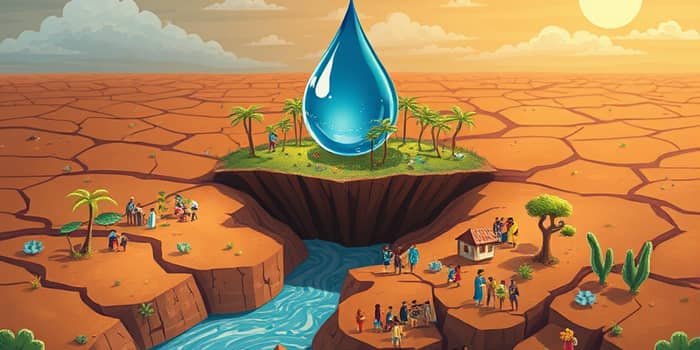
Water is the lifeblood of every ecosystem, economy, and community on Earth. Yet today, we stand at a crossroads: a global crisis of water scarcity threatens billions of lives, jeopardizes economic stability, and endangers our collective future. In this comprehensive exploration, we unveil the scale of the crisis, dissect its causes, and chart a path toward resilience through strategic investment.
Armed with data, human stories, and innovative solutions, this article seeks to inspire urgent action and guide stakeholders toward practical steps that can secure a sustainable future for all.
The numbers are staggering. Every year, we lose an estimated 324 billion cubic meters of freshwater—enough water to supply 280 million people. Meanwhile, 2.2 billion individuals still lack access to safely managed drinking water, and 4.5 billion go without proper sanitation.
Global water consumption has soared sixfold over the past century, and since 2000, overall usage has climbed by 25%. Per capita renewable water availability has declined by 7% in the last decade. By 2030, demand could outstrip supply by 40% as the population approaches 8.5 billion.
Perhaps most alarming, by mid-century three out of four people could face drought impacts, 720 million may be at risk of displacement, and half the world’s population could reside in water-short areas. In these conditions, a child dies every two minutes from water-related diseases—a human toll that cannot be ignored.
Beyond human suffering, water scarcity casts a long shadow over global economies. A single standard deviation increase in scarcity can reduce output growth by up to 0.16% and fixed investment by nearly 0.42%. In some regions, climate-exacerbated scarcity costs as much as 6% of GDP.
Worldwide, inadequate water and sanitation services incur annual losses of $260 billion. Yet every dollar invested in universal access returns approximately four dollars in avoided health costs, increased productivity, and economic gains.
In the United Kingdom alone, water scarcity threatens £8.5 billion in economic growth over five years, including housing impacts and missed tax receipts. Globally, the economic value of freshwater ecosystems is estimated at $58 trillion—60% of global GDP. Yet by 2050, $70 trillion of that value will lie in regions under high stress.
Understanding what drives scarcity is essential to crafting effective solutions. Physical factors, such as drought, continental drying, and wetland degradation, have intensified. Meanwhile, human activities—particularly agriculture—account for 72% of withdrawals, often with two-thirds inefficient irrigation.
Rapid urbanization and population growth strain existing systems. In many regions, weak infrastructure and pollution from industrial waste, pesticides, and sewage compound the problem. Erratic supply patterns driven by climate change further aggravate stress, turning previously abundant basins into emerging hotspots.
For instance, Northern Africa has witnessed a 16% increase in withdrawals in the last decade, while Western Asia’s demographics fuel rising demand. These intertwined pressures form a complex web that demands integrated, innovative approaches.
Certain regions stand perilously close to the edge. Kuwait and Qatar rank among the lowest per capita water reserves, and Pakistan’s per person availability has plunged from 5,000 m³ in 1951 to under 1,000 m³ today. India, home to 18% of the world’s population but only 4% of its freshwater, faces critical threats along the Brahmaputra and other major river basins.
Other hotspots include Central America, Eastern Europe, Northern India, Sub-Saharan Africa, and the Middle East. Emerging stress zones like southeastern Brazil now contend with year-round scarcity, leaving 500 million people in perpetual risk.
In total, 17 countries face extremely high water stress, with another eight in vulnerable positions. These regions illustrate that scarcity respects no borders and requires a unified global response.
Despite the daunting outlook, hope emerges through targeted, strategic investment. The World Bank’s latest strategy advocates three pillars: efficient demand management, alternative supply development, and fair allocation across sectors. Together, these measures can transform scarcity into opportunity.
Policymakers must also incentivize smarter crop choices and satellite monitoring to optimize land and water use. Central banks and economic planners should integrate water metrics into financial risk assessments, recognizing that water resilience underpins broader economic stability.
The water scarcity crisis is a defining challenge of our era. Its resolution demands collaboration across governments, businesses, communities, and individuals. We must harness innovation, scale up proven solutions, and commit financial resources to where they will yield the greatest impact.
Every investment in water security is an investment in human health, economic prosperity, and environmental sustainability. If we act now—guided by data, driven by purpose, and united by hope—we can secure a future in which every person has access to the essential resource that sustains life. Our collective choices today will shape the world our children inherit. Let us choose wisely, invest boldly, and flow together toward a resilient tomorrow.
References