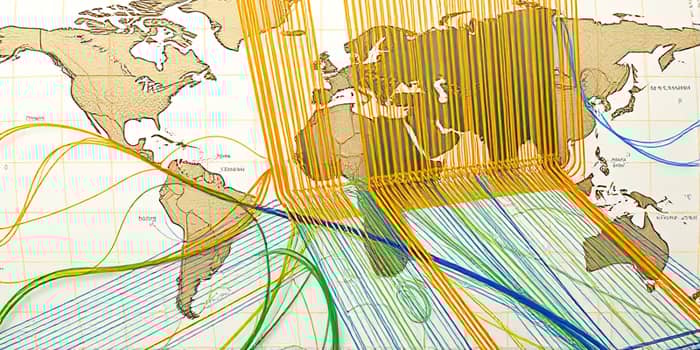
In an era defined by rapid market shifts, complex regulations, and evolving client needs, the art of weaving financial assets into a coherent strategy has never been more critical. Like a master weaver at a loom, the modern investor must integrate diverse threads—stocks, bonds, real estate, alternatives—into a tapestry that withstands time and turbulence.
By June 2025, global assets under management reached a record $147 trillion, reflecting investors’ search for growth, stability, and diversification amid shifting economic landscapes.
Key trends shaping the asset-management world include:
In this environment, wealth managers now prioritize organic client growth is more important over mere market-driven expansion, and champion holistic, outcome-based wealth management solutions tailored to individual aspirations.
At the heart of every resilient portfolio lies the loom of foundational techniques: asset allocation, diversification, and rebalancing.
Asset allocation dictates how much to invest in broad categories—equities, bonds, cash, real assets, and alternatives—and stands as the primary driver of portfolio risk and return, often outweighing security selection.
Diversification involves spreading investments across asset classes, sectors, regions, and styles to combine assets that are not perfectly correlated, reducing idiosyncratic risk and enabling improve risk-adjusted returns over time.
Rebalancing your portfolio periodically ensures you maintain your intended risk profile, avoiding unintended overexposure to assets that have run ahead.
Just as a weaver selects threads of varying textures and hues, investors choose from an array of asset types to build a vibrant financial tapestry.
Stocks drive long-term growth with volatility. Diversifying within equities by market capitalization, sector, and geography captures dynamic market opportunities while managing risk.
Bonds and fixed income offer income and stability, spanning government, corporate, municipal, investment-grade, and high-yield instruments across different maturities to cushion equity market swings.
Real assets deliver inflation protection and diversification. Real estate investment trusts (REITs) and commodity ETFs give investors exposure to property and raw materials, serving as hedges when traditional markets falter.
Alternatives and private markets—private equity, private credit, hedge funds, infrastructure, venture capital—provide an illiquidity premium and different risk and return drivers, enhancing portfolio resilience.
Every masterpiece begins with a clear design. Your financial blueprint should reflect goals, timelines, and risk tolerance.
By blending rigorous planning with cutting-edge platforms, you can craft a living tapestry that flexes with market cycles and personal milestones.
Even the finest design unravels without careful maintenance. Behavioral biases—like favoring familiar domestic markets—can erode diversification benefits. Embracing personalization of portfolio construction fosters alignment between investments and individual values.
Strategically, we’re witnessing the convergence of different asset management approaches as public and private markets merge in hybrid vehicles. This trend expands accessibility, allowing investors to tap diverse returns seamlessly.
The modern Wealth Weaver recognizes that no two tapestries are identical. Customization, underpinned by robust frameworks, yields patterns that not only endure but also reflect the weaver’s unique vision.
The tapestry of wealth is woven thread by thread, choice by choice. By understanding the global landscape, mastering allocation and diversification, selecting the right asset threads, planning with precision, and accounting for human behavior, you transform a disparate collection of holdings into a cohesive, resilient masterpiece.
As you embark on this weaving journey, let continuous learning and disciplined execution guide your shuttle across the loom. The world’s financial tapestry is ever-evolving; stay curious, refine your weave, and watch your assets harmonize into a legacy that spans generations.
References