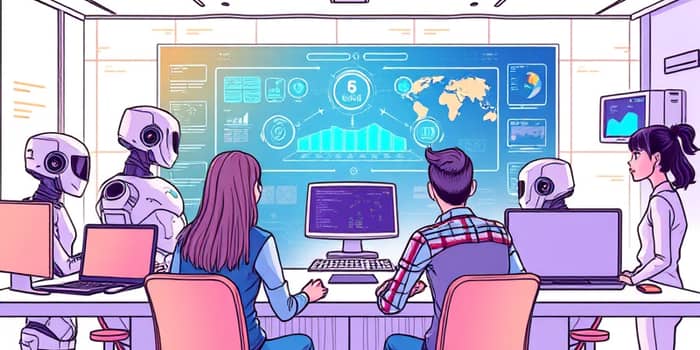
In 2026, the workplace is poised for a revolution, driven by intelligent systems that promise to redefine how we achieve our goals. The future centers on AI agents transforming every task from mundane to strategic, creating a landscape ripe for investment.
This shift isn't about replacing human ingenuity but amplifying it through seamless collaboration. Hybrid human-AI teams will orchestrate workflows at an enterprise scale, turning vision into reality with precision and speed.
As costs and complexities challenge early adopters, the imperative to invest wisely has never been clearer. Strategic workforce redeployment and efficient hardware are becoming cornerstones of sustainable growth in this new era.
By 2026, AI will evolve from simple tools to dynamic partners capable of autonomous decision-making. Super agents will plan and execute complex tasks across browsers, editors, and inboxes, making them indispensable in daily operations.
These systems combine analytical and generative AI for adaptability in real-world scenarios. Agentic operating systems standardize safety and compliance, ensuring that AI swarms work harmoniously under human guidance.
Multimodal agents bridge language, vision, and action, excelling in domains like healthcare and legal services. Smaller, domain-specific models outperform giant ones by reflecting expert workflows and continuous learning.
This evolution marks a leap from assistance to true collaboration, where AI anticipates needs and acts proactively. Investment in these technologies is critical for staying ahead in competitive markets.
Productivity gains will scale dramatically as AI integrates deeper into organizational processes. The four stages of AI transformation outline this journey, from modest improvements to exponential output.
At the autonomy stage, humans become orchestrators, focusing on creativity while AI handles execution. This enables small teams to launch global campaigns with efficiency once thought impossible.
Challenges remain, such as 54% of employees struggling with AI tool usage. Leadership visibility and training are essential to maximize return on investment and drive adoption.
The future of work thrives on partnerships between people, agents, and robots. Hybrid intelligence teams combine human empathy with AI's analytical power, creating synergistic outcomes.
Only 7% of enterprises achieve Dynamic Organization status, but they are 20 times more productive. AI optimizes workforce structure by redeploying talent from redundant roles to oversight and strategy.
This shift requires a cultural embrace of AI as digital coworkers. Trust-building security measures must underpin decision-making roles to ensure safe and effective collaboration.
By focusing on amplification rather than replacement, organizations can unlock new levels of innovation. Research acceleration with AI lab assistants is already generating hypotheses and running experiments faster.
Beyond GPUs, the hardware landscape is diversifying to support agentic workloads. ASICs, chiplets, and quantum-assisted optimizers are maturing, enabling more efficient AI infrastructure.
Edge AI is becoming a reality, allowing real-time processing in decentralized environments. Dense superfactories with dynamic routing prioritize sustainability and intelligence quality over mere size.
Robotics autonomy is driven by agentic AI, enabling independent robots in logistics and manufacturing. Investment in these innovations is key to scaling automation without compromising performance.
This hardware evolution supports the seamless operation of multi-agent systems. Efficient infrastructure reduces costs and environmental impact, making AI investments more sustainable.
Enterprise workflows are being reimagined as AI tackles end-to-end complex tasks, such as procurement. True machine automation creates new platforms and markets, offering growth opportunities.
However, 42% of companies abandon AI investments due to high costs and minimal impact. 2026 marks an inflection point with maturing capabilities, requiring a shift from experimentation to execution.
Open-source AI models foster global diversification and interoperability. Domain-enriched models reflect expert workflows, enhancing reliability and adoption across industries.
Security remains paramount, with AI agents needing robust safeguards for trusted decision-making. Proactive governance prevents silos and ensures compliance in an increasingly automated world.
C-suites must prioritize strategic shifts to harness AI's full potential. Invest in human-AI amplification over replacement, focusing on dependable systems rather than proofs-of-concept.
The seven AI workforce trends highlight critical areas for action, from skills shifts to execution focus. ROI awakening emphasizes reliable outcomes, driving investments toward technologies that deliver tangible value.
Economic imperatives call for open standards to prevent fragmentation. Automation drives efficiency in the AI-work economy, positioning forward-thinking leaders for success.
By embracing these imperatives, organizations can navigate the complexities of 2026 and beyond. The future isn't about replacing humans it's about amplifying them, creating a legacy of innovation and resilience.
References