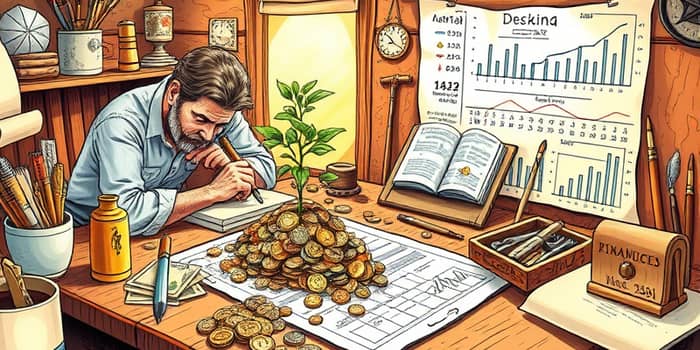
As we step into 2026, a period of moderated inflation and evolving markets offers a fresh canvas to design your financial future with intention and creativity.
With price growth cooling yet household budgets stretched and interest rates stabilizing after 2025 peaks, there has never been a more critical moment to apply artisanal care to your assets.
Becoming an asset artisan means shifting from reactive survival to proactive design. By viewing your finances as a work of art, you gain clarity, purpose, and resilience amid economic fluctuations. This mindset empowers long-term financial resilience and ensures each decision aligns with your core values.
Just as a master craftsman studies materials and tools before beginning, an artisan invests time to understand economic trends—from cooling inflation data from the BLS to BEA indicators on consumer spending—so that each stroke of strategy is deliberate.
To build your ideal financial life, follow this nine-step framework that transforms raw resources into a structured masterpiece.
Gather total income, fixed expenses, variable costs, current savings, and outstanding debts. Use data from the Bureau of Labor Statistics and Bureau of Economic Analysis to identify rising cost categories, such as housing and healthcare.
Organize this information in a detailed spreadsheet or budgeting app to visualize cash inflows and outflows, revealing pressure points and opportunities for reallocation.
Anchor your goals in personal values—security, freedom, legacy—and classify them into must-haves and nice-to-haves
Allocate income using the 50-30-20 rule
Set up transfers to savings, retirement accounts, and sinking funds for irregular expenses like insurance premiums and taxes. These Pre-Authorized Contributions remove manual friction and reinforce consistency.
Automation reduces the risk of missed contributions and entrenches disciplined habits that compound benefits over time.
List debts by interest rate, pay minimums on all, then direct extra payments (for example, an extra $150 per month) toward the highest-rate obligations. Consider refinancing when interest rates ease below peak 2025 levels.
For Canadian residents, consolidating credit card balances or leveraging lower-rate personal lines of credit can reduce overall interest outlays.
Maintain liquidity buffers and dedicated sinking funds to cover emergencies, from job disruptions to medical needs. This buffer keeps you from derailing progress when surprises arise.
Structure sinking funds into categories—auto maintenance, property taxes, holiday spending—to avoid annual budget shocks.
Capitalize on tax-advantaged vehicles
Review withholding using IRS tools, maximize HSA advantages, claim Canadian tax credits (GST relief for first-time new builds), and update estate documents to solidify your legacy.
Small adjustments—like optimizing HSA contributions or adjusting payroll withholdings—can free up cash for higher-priority investments.
Set specific targets—such as increasing emergency savings by $4,000 annually or hitting $500 per month in retirement investments—and review progress quarterly. Adjust goals for life events like weddings, home purchases, or career changes.
Use visualization tools like progress bars and milestone alerts to stay motivated and celebrate each achievement.
Regular check-ins transform a static plan into a living blueprint. Track key performance indicators—savings rate, debt reduction pace, portfolio allocation—and compare them against your personalized benchmarks.
For instance, if housing costs spike beyond your 50% needs allocation, reallocate discretionary spending or tap into the flexibility of your sinking funds. This adaptive approach fosters financial longevity in an uncertain economy.
By analyzing your metrics against national trends—like BLS consumer expenditure data—you can proactively adjust to shifts in transportation or food prices before they erode your financial stability.
Even seasoned artisans face missteps. Watch for these pitfalls:
Equip yourself with resources like comprehensive budgeting apps (e.g., YNAB, Mint), customizable spreadsheets, and professional guidance—from CFPs to financial academies. In Canada, leverage the new middle-class tax cut (14% lowest federal rate, saving up to $840 per couple) and FHSA options for first-time homebuyers.
Don’t overlook growth opportunities in sectors poised for expansion. As volatility creates entry points, allocating a portion of your portfolio to tech and AI-focused funds can capture long-term upside, while fixed-income allocations protect against sudden downturns.
Crafting an ideal financial life as an asset artisan is both an art and a science. It demands intentional planning, disciplined execution, and relentless adaptation to evolving markets. With cooling inflation, stabilizing interest rates, and emerging opportunities in tech and fixed-income sectors, 2026 presents a fertile landscape for growth.
Embrace this process with patience: build your foundation, fine-tune your blueprint, and celebrate every milestone. By treating your finances as a bespoke creation—shaped by purpose and polished by diligence—you unlock not just wealth, but the freedom to live on your own terms.
Pick up your tools and start crafting today. Review your plan, consult with trusted advisors, and set a date for your next financial audit in December 2026. Your masterpiece awaits.
References