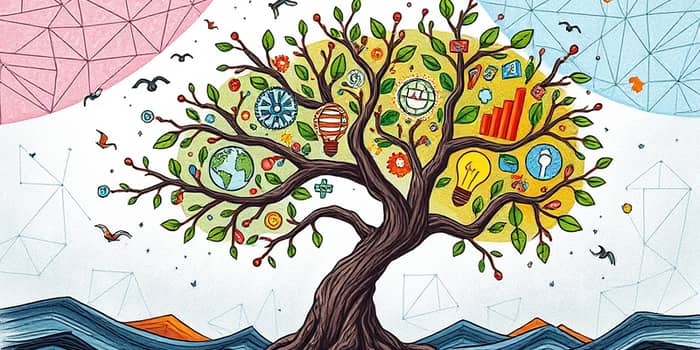
In today's fast-paced world, change is the only certainty, shaking industries and redefining success.
To navigate this turbulence, businesses and individuals must embrace adaptive advantage, a powerful concept that transforms uncertainty into opportunity.
It's about moving beyond rigid plans to foster flexibility and rapid adjustment, ensuring superior outcomes in unpredictable environments.
This mindset shift isn't just for survival; it's the key to thriving and leading in chaotic times.
Imagine facing disruptions like technological shifts or market crashes not as threats, but as chances to innovate and grow stronger.
Adaptive advantage empowers you to do just that, by cultivating readiness, responsiveness, and resilience.
At its heart, adaptive advantage is about achieving better results through continuous learning and adaptation.
It involves iterative experimentation and quick feedback loops, allowing for timely course corrections.
Unlike traditional strategies that rely on long-term forecasting, this approach thrives on dynamism and agility.
Key attributes include:
These qualities are not static; they are developed through ongoing processes that evolve with the environment.
For instance, in business, this means pivoting models or diversifying supply chains proactively.
On a personal level, it involves continuous skill development and openness to new opportunities.
To implement adaptive advantage, structured models can provide a clear roadmap for action.
One powerful framework is the VSAM Loop, which stands for Variation, Selection, Amplification, and Modulation.
This loop emphasizes learning and iteration, making it ideal for high-change scenarios.
Another useful model is the Four Styles of Adaptive Strategy, which helps tailor your approach to market turbulence.
Choosing the right style depends on your industry's volatility and your capacity for change.
Additionally, the Adaptive Strategy Execution Framework incorporates elements like agility, innovation, and transparent collaboration.
It uses tools such as OKRs to align teams and track progress effectively.
Applying adaptive strategies can transform both organizations and individual careers.
In business, this means embedding adaptability into every process through operational assessments and agile methodologies.
Benefits include greater speed, enhanced resilience, and improved foresight via data analytics.
For personal growth, adaptive advantage involves cultivating a mindset of continuous learning and flexibility.
Leaders play a crucial role by modeling flexibility and encouraging experimentation and tolerance for failure.
This creates a culture where challenges are reframed as opportunities for growth.
Disruptions, whether from technology or global events, can be leveraged for innovation.
The key is to start with small, controlled experiments that provide quick feedback.
Scale successes gradually while learning from failures to avoid costly mistakes.
Networks and collaborations amplify your ability to adapt by expanding options and insights.
An always-on strategy ensures that execution is driven by real-time feedback, bridging current and desired outcomes.
This approach reduces risks associated with rigid planning in volatile environments.
History offers valuable lessons on the power of adaptation.
Companies that failed to adapt, such as those ignoring cultural shifts, often collapsed.
In contrast, those embracing change, like Netflix and Amazon, thrived by continuously evolving.
These examples show that success comes from pivots and experimentation, not perfect plans.
Adaptive advantage provides a competitive edge by supplementing traditional strengths with signal and systems advantages.
To start your journey, ask critical questions that assess your current adaptability.
Use tools like agile sprints and data analytics to support continuous improvement.
Foster a culture that values learning and innovation at all levels.
Remember, adaptability scales from individuals to large organizations, enabling growth in any setting.
As technology and AI continue to disrupt, adaptive advantage will become even more essential.
Embrace this mindset to not only survive but thrive, turning every challenge into a stepping stone for success.
By cultivating readiness, responsiveness, and resilience, you can navigate uncertainty with confidence and creativity.
References