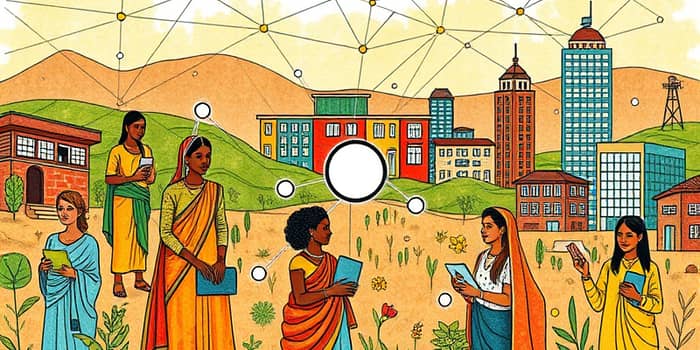
In an age of global connectivity, small loans are creating monumental change. From bustling city markets to remote village communities, microfinance is redefining the trajectory of economic development. This article delves into the transformative power of microfinance, translating daunting statistics into human stories of resilience, ambition, and collective prosperity.
Over the past decade, the microfinance sector has recorded remarkable expansion. Industry reports estimate the global market at USD 285.03 billion in 2026 and project a rise to USD 480.73 billion by 2031 at an 11.02% CAGR from 2026-2031. Alternative analyses confirm this trajectory, suggesting values between USD 239 billion and USD 693 billion across various horizons. These projections highlight a sustained appetite for financial inclusion vehicles worldwide.
This robust growth is underpinned by an increasing demand for small-scale credit among underserved populations. In India alone, the microfinance gross loan portfolio hit INR 3.81 lakh crore (USD 45.9 billion) by March 2025. Elsewhere, emerging markets in Latin America, Sub-Saharan Africa, and Southeast Asia mirror these upward trends as policymakers and private institutions unlock new avenues for lending.
Geography shapes the microfinance narrative, revealing pockets of extraordinary expansion and innovation.
Several critical factors accelerate microfinance growth and expand its reach:
National initiatives like India’s Jan Dhan Yojana have enrolled over 500 million people into formal banking, boosting microfinance penetration. Embedded finance, where digital platforms integrate lending directly into commerce workflows, adds a further 1.6% to sector CAGR, especially impactful in Africa and South Asia. Meanwhile, the $5.7 trillion MSME credit gap underscores the urgent need for tailored loans and capacity-building.
Microfinance extends beyond credit, offering services that uplift entire communities:
Among end-users, business borrowers make up about 66.28% of demand in 2025, with a growing focus on women-owned enterprises. In many regions, MFIs complement loans with training, mentorship, and collateral-light lending, empowering entrepreneurs to maximize impact.
Despite its promise, microfinance faces hurdles that require strategic solutions:
Regulatory tightening in major markets like India slowed disbursals in 2025, tempering growth forecasts to a conservative 12-15% for FY2026. Overleveraging concerns prompted stricter supervision, demonstrating the delicate balance between rapid scale-up and financial stability.
Structural challenges remain in remote regions where digital connectivity is poor and operational costs are high. MFIs must invest in mobile networks, staff training, and fintech integration to reach the last mile effectively.
Microfinance is more than another financial sector—it is a catalyst for inclusive economic transformation. As the sector expands to serve over 16 million low-income individuals globally, the human stories behind each loan are what truly define its success. Small traders in Nairobi, women artisans in rural Bangladesh, and startup founders in Colombia all share the same path: a chance to build assets, provide for families, and contribute to local economies.
Looking forward, collaboration among governments, MFIs, fintech innovators, and impact investors will be crucial. By combining policy support with cutting-edge technology and deep community engagement, the next decade could see microfinance bridging unprecedented credit gaps and unlocking fresh waves of entrepreneurship.
In a world seeking sustainable growth and equitable opportunity, microfinance stands out as a beacon of hope. It reminds us that true economic resilience is built one micro-enterprise at a time, and that every small loan has the potential to spark lasting change.
References