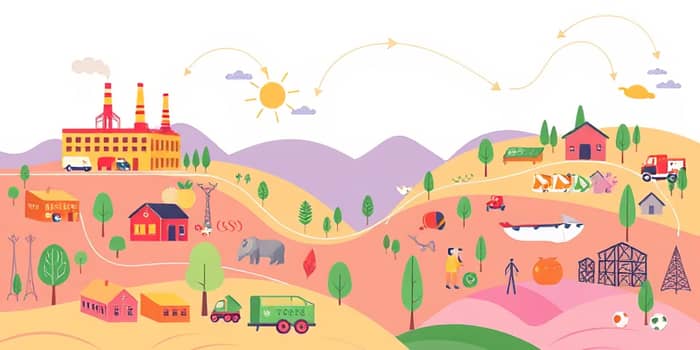
Imagine your local economy as a living, breathing entity that thrives on new energy from the outside world. This energy comes from the economic base, the core industries that export goods and services beyond regional borders.
Without this external infusion, communities risk stagnation, merely recirculating money internally. It is often compared to taking in each other's washing, a metaphor highlighting the limits of growth without fresh inputs.
By grasping this concept, you can unlock strategies for personal and collective financial resilience. Start with basic industries that drive growth, setting the stage for a prosperous future built on solid ground.
The economic base is divided into two key components: basic and non-basic industries. Basic industries export products or services, bringing in new money from outside the region.
Non-basic industries, on the other hand, serve the local population and support the basic sectors. They recirculate income within the community, creating a multiplier effect that amplifies economic impact.
This dual structure forms the backbone of regional economies, influencing everything from job creation to infrastructure development. External income injection is essential for sustaining long-term growth and preventing economic decay.
To identify basic industries, economists use the Location Quotient (LQ), a metric that compares regional employment concentration to the national average. An LQ greater than 1.0 indicates a surplus for export, signaling a strong basic sector.
The Economic Base Multiplier (EBM) quantifies the ripple effect of basic industries. It measures how many total jobs are created for each basic job, including indirect support roles.
For example, if 500 new basic jobs are added with an EBM of 2.0, the total employment increase could be 1,000 jobs. This multiplier effect is powerful for forecasting economic expansion and planning resources.
Strengthening your economic base requires a proactive approach, whether for a region or personal finances. Diversification is key to resilience, reducing reliance on a single industry and mitigating risks from market shifts.
Start by identifying local strengths through data analysis, such as employment statistics and LQ calculations. Allocate resources to infrastructure and incentives that support these basic sectors.
Policy tools can attract and expand basic industries, fostering sustainable growth. Tax incentives and export promotion are effective methods for stimulating economic activity and creating new opportunities.
Real-world examples illustrate the power of a strong economic base. Consider Mary's Fruit Farm, which exports produce nationally, injecting new income into its local community and supporting nearby businesses.
In Ottawa, federal government services act as a basic industry, providing jobs and stability that ripple through the regional economy. Manufacturing plants in small towns often dominate employment, driving growth and community development.
These cases show how export-driven activities fuel prosperity and highlight the importance of strategic planning. By learning from such examples, you can apply similar principles to your own financial foundation.
While economic base analysis is valuable, it has assumptions and criticisms that require consideration. It often oversimplifies by focusing solely on exports as the growth source, ignoring other factors like investment or government spending.
Assumptions include constant export-to-service ratios and homogeneous industries, which may not hold in dynamic economies. Data gaps in employment and output can lead to inaccuracies, making it better for structural analysis than precise forecasting.
Critics argue that over-reliance on a few basics can make regions vulnerable to economic downturns. However, by acknowledging these limits, you can use the theory as a guide rather than a rigid rule.
The principles of economic base extend to personal and national financial health. Credit allocation to productive investments is essential, directing resources toward equity over debt for sustainable growth.
Financial markets play a crucial role in efficiently allocating credit, a factor often overlooked in traditional models. Government policies, such as monetizing debt through deficits, can stimulate economies by creating new money.
Foreign exchange constraints highlight the need for export dollars to fund imports, emphasizing the importance of a strong basic sector. Innovation and balanced distribution ensure demand and regional stability, with governments acting as gardeners for credit flow.
To apply economic base theory effectively, focus on key metrics and data sources. Location Quotient (LQ) helps identify industry concentrations, while the Economic Base Multiplier (EBM) estimates job creation impacts.
Data needs include employment by industry, comparing regional and national figures to spot surpluses. Regular analysis of these metrics enables informed decision-making for growth strategies and resource allocation.
By tracking these indicators, you can adapt to changing economic conditions and build a foundation that withstands uncertainties. Embrace a data-driven approach to maximize the benefits of your economic base.
Building a strong economic base is not just an academic exercise; it is a practical path to financial security and growth. Start by identifying and nurturing export-oriented activities that bring new wealth into your sphere, whether as an individual or community.
Embrace diversification to mitigate risks and leverage multipliers for amplified impact. Use data-driven strategies to allocate resources wisely and foster resilient systems that thrive in uncertainty.
Remember, the economic base theory offers a blueprint for prosperity. By applying its principles, you can transform challenges into opportunities and lay a foundation that supports lasting success. Take action today to build a future grounded in strength and innovation.
References