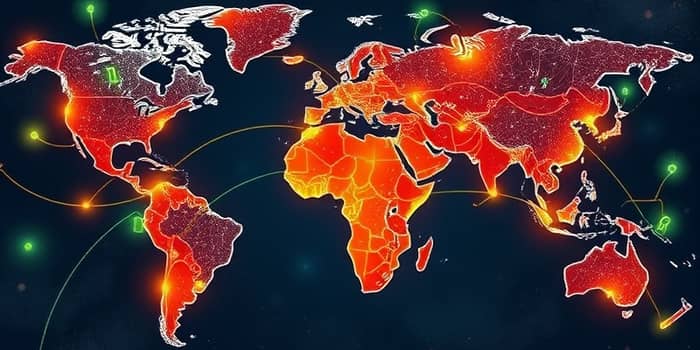
Emerging markets stand at the crossroads of transformation and opportunity. As investors seek new avenues for growth, these dynamic economies offer a blend of promise and volatility that demands careful navigation. From the digital highways of Southeast Asia to the renewable energy ambitions of India and Brazil, a complex mosaic of trends is reshaping global finance. This article provides a detailed, expert-driven guide to understanding, evaluating, and investing in emerging markets.
Emerging markets (EM) are economies experiencing rapid growth and industrialization, often outpacing their developed counterparts. They represent a middle ground between advanced economies and frontier markets—the latter being in even earlier stages of development with smaller, less accessible capital markets.
The MSCI Emerging Markets Index serves as the primary classification benchmark. Frontier markets are typically those not included in MSCI’s list but showing gradual investor accessibility. Recognizing this distinction is key for diversification and risk management.
Emerging markets today account for nearly 45% of global GDP and more than 55% of the world’s population (Trust Intelligence, 2025). By 2035, they are expected to drive approximately 65% of global economic growth, with an average GDP growth rate of 4.06% versus 1.59% in advanced economies (S&P Global, 2025).
Asia-Pacific dominates this expansion. China and India lead the pack, but smaller economies like Vietnam, the Philippines, and Bangladesh are posting annual growth rates above 6%. India is poised to become the world’s third-largest economy by 2035, while Indonesia and Brazil are projected to rank eighth and ninth, respectively.
Emerging market equities have outperformed in recent years. The MSCI Emerging Markets IMI Index rose roughly 12.7% in Q2 2025, topping both the MSCI World and S&P 500 indices (VanEck, 2025). According to Goldman Sachs, this rally may continue through year-end, driven by a weakening U.S. dollar and renewed risk appetite.
Successful allocation in emerging markets requires a blend of selectivity and diversification. Not all EMs perform equally—sectoral strength and policy frameworks vary significantly. Investors should consider:
Each region presents unique drivers and challenges. A granular understanding helps tailor investment theses:
India continues to post consistent 7.1% annual growth, fueled by reforms, a burgeoning tech sector, and aggressive green infrastructure investments. China remains pivotal but faces capital flow pressures; its policy shifts and stabilization efforts are critical to watch.
Africa’s fintech revolution and young demographics offer long-term promise, even as political fragmentation and infrastructure gaps persist. In the Gulf, the UAE and Saudi Arabia are leveraging cheap energy to build AI and digital economies, drawing global investors.
Despite optimism, emerging markets face headwinds. Global foreign direct investment to EM fell 11% in 2024 to $1.5 trillion (UNCTAD, 2025), reflecting increased uncertainty. Protectionist policies and geopolitical conflicts add layers of complexity.
Climate resilience is a pressing concern. Frontier economies may need $215–$387 billion annually this decade for adaptation, a significant burden relative to GDP. Investors should integrate environmental risk assessments into portfolio construction.
Looking ahead, EMs that diversify trade partnerships, invest in digital and green infrastructure, and maintain sound macro policies are poised to lead the next wave of global growth. Building resilience through regional alliances and focusing on structural reforms will be crucial to sustain momentum.
Emerging markets are not a monolith but a tapestry of evolving stories. By adopting a strategic, research-driven approach—grounded in robust risk management—investors can unlock the vast potential these economies hold. In an era of shifting power dynamics, EMs offer a frontier of opportunity for those ready to explore beyond the traditional boundaries of global finance.
References